Part 1 · Keeping the books · Chapter 1.8
The trial balance
Draft: the wording may change.
The idea
The trial balance lists every account with its closing balance, debits on one side and credits on the other. Since every entry balances, the two totals must be equal. If the scale is not level, something is broken.
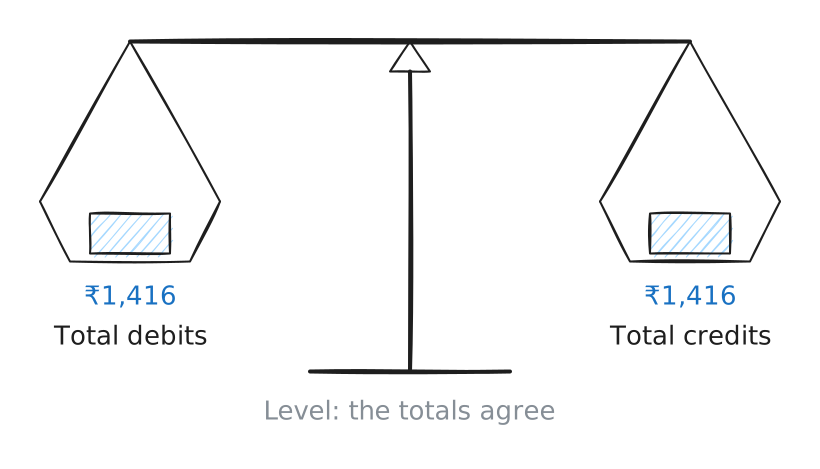
At the counter
Take the twelve postings for Ravi Stores in October from chapter 1.7 and add them up account by account:
| Account | Debit | Credit |
|---|---|---|
| Cash | 1,336 | |
| Sundry Debtors | 80 | |
| Customer Advances | — | — |
| Sales | 1,200 | |
| GST Output | 216 | |
| Total | 1,416 | 1,416 |
The scale is level. Every amount on it is a total of postings — nothing is typed in separately.
What a level scale proves — and what it does not
A level trial balance proves that the arithmetic holds: every entry was recorded with equal debits and credits. It does not prove the books are right. It will still balance when:
- an entry was missed completely (a bill never entered),
- an entry went to the wrong account on the right side (rent posted to Salary),
- the same wrong amount was used on both sides (₹1,180 entered as ₹1,810 everywhere),
- two mistakes cancel each other out.
So the trial balance is the first check, not the last. Chapter 1.18 adds the others.
Common mistake
Treating a balanced trial balance as "the books are correct" and stopping there. Check the accounts that matter most — cash, bank, debtors, GST — against outside evidence as well.
Where you'll use this
In Part 3, before raising month-end claims or sending secondary-sales data to a company, the stockist checks that the trial balance is level. Claims built on unbalanced books get questioned.
Check yourself
- In the Ravi Stores example, what are total debits and total credits?
- Name one mistake a trial balance cannot catch.
- Where do the numbers in a trial balance come from?
Answers
- ₹1,416 on each side.
- Any of: a missed entry, the wrong account on the right side, the same wrong amount on both sides, mistakes that cancel out.
- From totals of the postings, account by account.