Part 1 · Keeping the books · Chapter 1.5
Postings and journal entries
Draft: the wording may change.
The idea
A posting is the smallest thing in accounting: one line, to one account, on one side, for one amount. A journal entry is a group of postings for one business event, and its debits equal its credits. In a modern business, the bill is the entry.
The four building blocks
Everything in the books is made from four pieces:
- Source document — the evidence: a bill, a receipt, a bank slip.
- Journal entry — one balanced business event, produced by the document.
- Postings — the single debit or credit lines that make up the entry.
- Accounts — the named buckets each posting lands in.
A document produces an entry, the entry is made of postings, and each posting lands in an account. Only these are stored. The journal, the ledger, the trial balance, the profit and loss, the balance sheet, the GST reports — every one of them is calculated from the postings.
At the counter
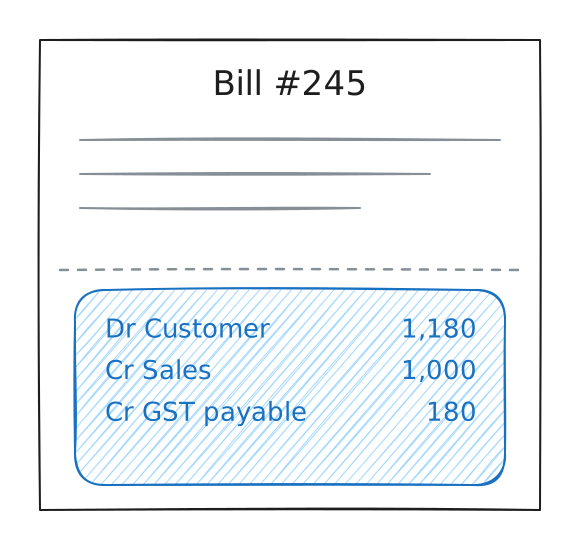
On 5 October we bill Ravi Stores: goods ₹1,000, GST ₹180, total ₹1,180. Bill #245 produces one entry with three postings:
| Posting | Account | Debit | Credit |
|---|---|---|---|
| p3 | Sundry Debtors (Ravi Stores) | 1,180 | |
| p4 | Sales | 1,000 | |
| p5 | GST Output | 180 | |
| Total | 1,180 | 1,180 |
Every entry follows four rules: it has two or more postings, they share one date, they come from one source document, and total debit equals total credit.
The bill and the entry
On paper, a clerk read the bill and wrote the entry into a separate journal book. In software the two are merged: saving the bill writes its postings. That is why we say the bill is the entry.
But keep the two ideas apart in your head. The bill says what happened. The entry is the accountant's translation — which accounts, which sides. The translation can be wrong even when the bill is right, and that translation is what an auditor checks.
Common mistake
Writing a journal voucher for something that has a document — for example, recording a sale as a journal entry instead of raising an invoice. The books balance, but the evidence is missing, the GST reports miss the sale, and nobody can trace the entry back to a customer's bill.
Where you'll use this
In Part 3, a company's credit note for a scheme is one document with its own postings: debit the company's account, credit scheme income or purchases. Read the credit note the way you read bill #245.
Check yourself
- Bill #245 has three postings. How many accounts does it touch?
- What are the four rules of a journal entry?
- If the bill is correct, can the entry still be wrong?
Answers
- Three: Sundry Debtors (Ravi Stores), Sales and GST Output.
- Two or more postings, one date, one source document, total debit equals total credit.
- Yes. The wrong account or wrong side can be chosen even when the bill's numbers are right.