Part 1 · Keeping the books · Chapter 1.7
The journal and the ledger
Draft: the wording may change.
The idea
The journal and the ledger hold the same postings. The journal sorts them by date and groups them by event. The ledger picks one account and adds a running balance. Nothing new is written — the same lines are sorted twice.
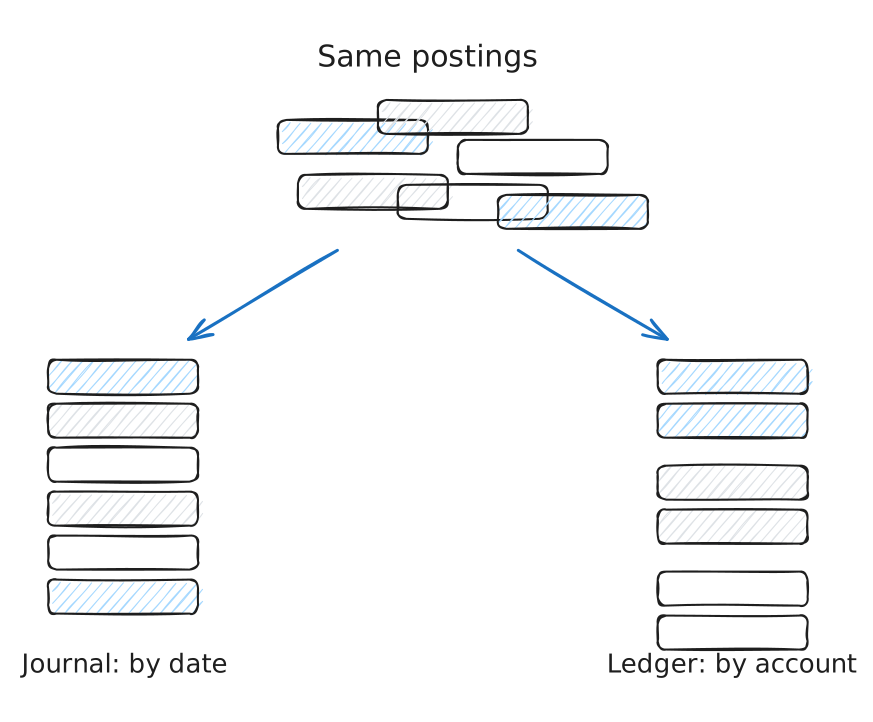
One worked example: Ravi Stores in October
- 1 Oct — Ravi Stores pays an advance of ₹500 in cash.
- 5 Oct — Bill #245 to Ravi Stores: goods ₹1,000 + GST ₹180 = ₹1,180. The advance is adjusted against it.
- 10 Oct — Ravi Stores pays ₹600 in cash.
- 12 Oct — A cash sale, bill #246: goods ₹200 + GST ₹36 = ₹236.
Before reading on, guess: at the end, does Ravi owe us, or do we owe Ravi — and how much?
What is actually stored: twelve postings
| # | Date | Document | Account | Party | Debit | Credit |
|---|---|---|---|---|---|---|
| p1 | 1 Oct | Receipt R-01 | Cash | 500 | ||
| p2 | 1 Oct | Receipt R-01 | Customer Advances | Ravi | 500 | |
| p3 | 5 Oct | Bill #245 | Sundry Debtors | Ravi | 1,180 | |
| p4 | 5 Oct | Bill #245 | Sales | 1,000 | ||
| p5 | 5 Oct | Bill #245 | GST Output | 180 | ||
| p6 | 5 Oct | Adjustment J-01 | Customer Advances | Ravi | 500 | |
| p7 | 5 Oct | Adjustment J-01 | Sundry Debtors | Ravi | 500 | |
| p8 | 10 Oct | Receipt R-02 | Cash | 600 | ||
| p9 | 10 Oct | Receipt R-02 | Sundry Debtors | Ravi | 600 | |
| p10 | 12 Oct | Bill #246 | Cash | 236 | ||
| p11 | 12 Oct | Bill #246 | Sales | 200 | ||
| p12 | 12 Oct | Bill #246 | GST Output | 36 |
This table is the whole truth. Every report below is calculated from these twelve lines.
View 1: the journal
Grouped by event, sorted by date. It answers what happened, and does each event balance? It has no running balances.
1 Oct   Receipt R-01      Cash                       Dr    500
                            To Customer Advances (Ravi)           500
5 Oct   Bill #245         Sundry Debtors (Ravi)      Dr  1,180
                            To Sales                            1,000
                            To GST Output                         180
5 Oct   Adjustment J-01   Customer Advances (Ravi)   Dr    500
                            To Sundry Debtors (Ravi)              500
10 Oct  Receipt R-02      Cash                       Dr    600
                            To Sundry Debtors (Ravi)              600
12 Oct  Bill #246         Cash                       Dr    236
                            To Sales                              200
                            To GST Output                          36
View 2: the ledger
One account at a time, with a running balance. Each line names the other account as a pointer.
Cash
| Date | Against | Debit | Credit | Balance |
|---|---|---|---|---|
| 1 Oct | Customer Advances | 500 | 500 Dr | |
| 10 Oct | Sundry Debtors | 600 | 1,100 Dr | |
| 12 Oct | Sales | 236 | 1,336 Dr |
Sales
| Date | Against | Debit | Credit | Balance |
|---|---|---|---|---|
| 5 Oct | Ravi Stores | 1,000 | 1,000 Cr | |
| 12 Oct | Cash | 200 | 1,200 Cr |
Bill #245 is one block in the journal but three lines on three different ledger pages.
View 3: the party statement
Filtered by party, across all its accounts:
| Date | Document | Account | Debit | Credit | Net balance |
|---|---|---|---|---|---|
| 1 Oct | R-01 | Customer Advances | 500 | 500 Cr (we owe Ravi) | |
| 5 Oct | #245 | Sundry Debtors | 1,180 | 680 Dr | |
| 5 Oct | J-01 | Customer Advances | 500 | 1,180 Dr | |
| 5 Oct | J-01 | Sundry Debtors | 500 | 680 Dr | |
| 10 Oct | R-02 | Sundry Debtors | 600 | 80 Dr — Ravi owes ₹80 |
The answer to the guess: Ravi owes us ₹80.
Every report is a view
| Journal | Ledger | Party statement | Trial balance | |
|---|---|---|---|---|
| Filter | All postings | One account | One party | All postings |
| Grouped by | Document | — | — | Account |
| Running balance | No | Yes | Yes (net) | Closing only |
| Answers | What happened? | Where does this account stand? | Where do we stand with this party? | Do the books balance? |
If the postings are right, every view is right automatically. If two reports disagree, a posting is wrong.
Balances are calculated, not written down
On paper, the clerk wrote a running balance on every ledger line because there was no other way. In software that is a trap: one backdated bill and every stored balance after it is wrong. The bank does not store your balance on every passbook line — it prints it when you update the passbook. A system may keep the current balance as a quick-lookup copy, but it must be rebuilt from the postings and checked.
Common mistake
Fixing a ledger or a statement by hand so it "matches". The report is only a view; change the posting (through its document) and every view corrects itself.
Where you'll use this
In Part 3, the outstanding statement a salesman shows a retailer on the beat is View 3. When the retailer says "I paid", you check the party statement line by line against the documents.
Check yourself
- Bill #245 has three postings. On how many ledger pages does it appear?
- Which view would you open to answer "what happened on 5 October"?
- Why should a system not store the running balance on every line?
Answers
- Three: Sundry Debtors (Ravi), Sales and GST Output.
- The journal (day book).
- A backdated edit would make every later stored balance wrong; calculate it when the ledger is shown.