Part 1 · Keeping the books · Chapter 1.1
Why keep accounts
Draft: the wording may change.
The idea
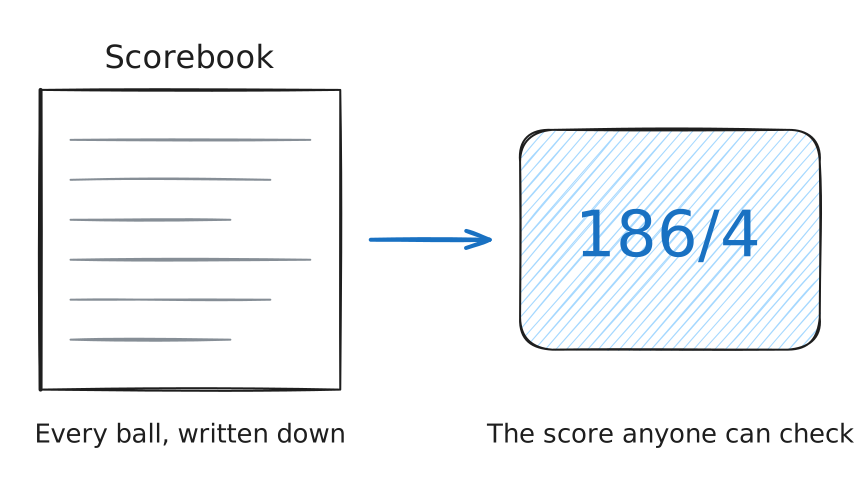
Accounts are the scorebook of a business. Without them, nobody can say who is winning — even though every ball was bowled.
At the counter
A stockist can be busy from morning to night. Goods go out, cash comes in, salesmen collect cheques, the company sends stock and a bill. At the end of the month the owner asks four simple questions:
- How much profit did we make?
- Who owes us money, and since when?
- How much do we owe, and to whom?
- How much stock should be on the shelf?
If nothing was written down — or it was written down in a way that cannot be added up — none of these questions has an answer. The work happened, but the score is lost.
Accounting is not paperwork for the auditor. It is the only way to know where the business stands.
The same idea for 500 years
Double entry — writing every movement of money from both ends — is old, and the books it uses have hardly changed.
| When | Who | Books kept |
|---|---|---|
| 1300s | Italian merchants in Genoa, Florence and Prato | Merchant ledgers with both sides |
| 1494 | Luca Pacioli, printed in Venice — the first printed description | Memorandum (rough day book), then journal, then ledger |
| Centuries | Indian traders' bahi-khata | Rojmel (daily cash book) and khata (ledger), with jama and udhar |
| 1900s | Shops and offices | Bill book, then sales and purchase day books, then ledger |
| Today | Tally, ERP and mobile apps | The bill itself is the journal entry; reports are calculated |
Pacioli did not invent double entry. He wrote down what Venetian merchants were already doing. The journal and the ledger he describes are the same two books this part of the book explains.
Common mistake
Treating accounts as something done "for the auditor" or "for GST" at the end of the year. Books written late are written from memory, and memory is where the money leaks.
Where you'll use this
In Part 3, every question a brand asks a stockist — secondary sales, claims, outstanding, stock days — is answered from these books. A stockist with a clean scorebook gets claims settled faster.
Check yourself
- Name two questions a shop owner cannot answer without accounts.
- What three books did Pacioli describe?
- In a modern billing app, what plays the part of the journal entry?
Answers
- Any two of: how much profit, who owes us, whom we owe, how much stock should be on the shelf.
- The memorandum (rough day book), the journal and the ledger.
- The bill (or receipt, or other document) itself — the software writes the entry from it.