Part 1 · Keeping the books · Chapter 1.2
Every entry starts with a document
Draft: the wording may change.
The idea
Every entry in the books starts with a piece of paper — a bill, a receipt, a delivery challan. The paper is the evidence. But not every paper creates an entry.
At the counter
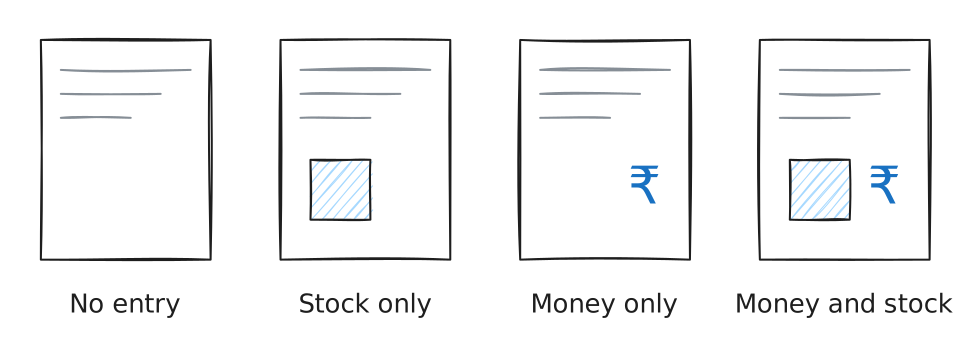
Look at the papers that cross a stockist's desk in one day. Each one does one of four things:
| Kind | Changes the books? | Moves stock? | Examples |
|---|---|---|---|
| No entry | No | No | Quotation, proforma invoice, sales order, purchase order |
| Stock only | No | Yes | Delivery challan, goods received note, godown transfer |
| Money only | Yes | No | Receipt, payment, salary, loan received or repaid, rent bill, bank charges, GST or TDS payment |
| Money and stock | Yes | Yes | Sales invoice, purchase bill, credit or debit note with goods returned |
The test: does this document change what the business owns or owes? A quotation or an order is a promise. Nothing has changed hands yet, so nothing goes into the books. A delivery challan moves goods but not ownership of money. A receipt moves money but no goods. An invoice does both.
There is one more kind of paper: the journal voucher. It is used only when there is no business document at all — opening balances, depreciation, corrections, year-end adjustments. If a real document exists, use it instead.
Common mistake
Assuming a document type always belongs to the same kind. A credit note for a price difference is money only. A credit note for returned goods is money and stock. Ask what actually moved.
Where you'll use this
In Part 3, scheme claims, damage claims and expiry returns each come with their own documents. Knowing which kind each one is tells you whether the claim changes stock, money or both — and why a claim without a document gets rejected.
Check yourself
- A retailer asks for a quotation and we send one. Which kind of document is it?
- Goods move from our main godown to a second godown. Which kind?
- When should you use a journal voucher?
Answers
- No entry — a quotation is a promise, not a transaction.
- Stock only — the goods move but nothing is bought or sold.
- Only when there is no business document, such as opening balances, depreciation or corrections.