Part 1 · Keeping the books · Chapter 1.4
Debit and credit
Draft: the wording may change.
The idea
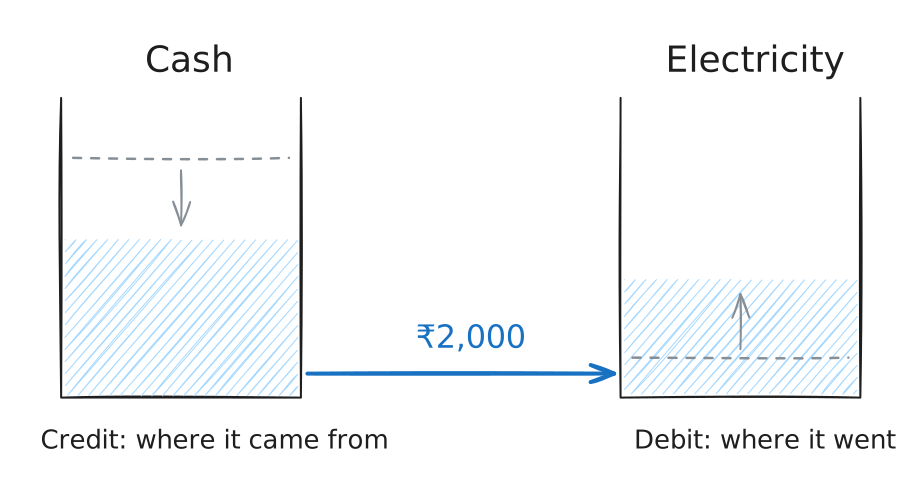
Every movement of money has two ends, like water flowing between two tanks. What leaves one tank enters the other. Debit is where the value went. Credit is where it came from.
At the counter
The shop pays a ₹2,000 electricity bill in cash.
- The Cash tank drops by ₹2,000. The value came from Cash, so Cash is credited.
- The Electricity tank rises by ₹2,000. The value went to Electricity, so Electricity is debited.
Two lines, same amount, opposite sides. That is double entry. Because every movement is written from both ends, total debits always equal total credits — for one entry, for one day, for the whole year.
Now a cash sale of ₹236: Cash rises (debit Cash 236), and the value came from the sale (credit Sales 200, credit GST Output 36). Three lines this time, but the two sides still match: 236 = 200 + 36.
The rules in one table
| Account type | To increase it | To decrease it |
|---|---|---|
| Asset | Debit | Credit |
| Expense | Debit | Credit |
| Liability | Credit | Debit |
| Equity | Credit | Debit |
| Income | Credit | Debit |
You do not need to memorise it if you remember the tanks: cash coming in means the Cash tank rises, so debit Cash. A supplier we now owe means the amount came from them, so credit the supplier.
Common mistake
Thinking debit means bad and credit means good, because a bank "credits" your account when money arrives. The bank is writing from its side — your deposit is money the bank owes you. Debit and credit are just the two ends of one movement.
Where you'll use this
In Part 3, when a company sends free goods under a scheme or approves a claim, you will need to say which tank fills and which one empties. Every claim settlement is one more pair of tanks.
Check yourself
- We pay ₹10,000 rent by bank. Which account is debited and which is credited?
- A retailer pays ₹600 in cash against an old bill. Which two accounts move?
- Does a debit always mean money went out of the business?
Answers
- Debit Rent (expense rises), credit Bank (asset falls).
- Debit Cash (it rises), credit the retailer's account (what they owe us falls).
- No. Debit means the value went to that account — for Cash, a debit is money coming in.